
What is Dharma? A Modern Guide to Hinduism’s Most Misunderstood Concept
How to live a dharmic Jeevan, a purposeful life. Here are foundational principles to Hinduism's ancient wisdom of Dharma to improve our daily habits, relationships, and personal integrity.
FEATURED
The concept of dharma
Stands as the most misunderstood pillar of HINDUISM, primarily because the modern West lacks a direct linguistic equivalent. Most people default to the word religion, but this is a categorical error. Religion implies a set of beliefs, a specific deity, and a historical revelation. Dharma, conversely, is derived from the Sanskrit root "dhri", which means to uphold, support, or maintain. What, would you ask? " 'THAT' which upholds! " It's "Actions [Dharmic Actions] which maintains the stability and harmony of the universe."
Dharma is not just for us. Take, for example, Fire’s dharma is to burn and a tree’s dharma is to bear fruits. This dharma principle also applies even to an inert material, like an electron’s dharma is to constantly moving in an orbit around proton and neutron. The day electrons decide to be a-dharmic and stop moving in that orbit, the world will fall apart in a second. Similar phrases to "Fire’s dharma is to burn and a tree’s dharma is to bear fruits" , A bee's dharma is to gather nectar, A dog's dharma is to be faithful. The Sun’s dharma is to give light/energy. It's a natural trait and it's purpose. They emphasize that every entity has an essential, inescapable, and natural role to play. It's Dharma as Natural Trait: As in "The cooling nature is the dharma of ice". it's inherent like 'the warmth of fire is inseparable from fire'.
Coming back to 'us', Dharma is the mode of conduct for an individual. It encompasses ethics, morality, natural laws & conduct. Dharma is, therefore, a conduct according to principles of universal order, social and moral conduct.
Dharmic traditions, originating in India, emphasize the "internal" discovery of Truth (Satya) or the nature of existence through experience, self-enquiry, and transformation The goal is to discover the divine within oneself rather than worshipping a separate divine entity. It is often experiential (Inductive) rather than dogmatic (Deductive). It's Righteous Action (Dharma) vs. Moral Code: Dharma is broader than a "moral code." At its core, dharma represents the fundamental laws that govern both the physical and moral worlds. Just as it is the dharma of fire to burn and the dharma of water to flow, human dharma is the alignment of one’s actions with the natural order.
Situational Ethics
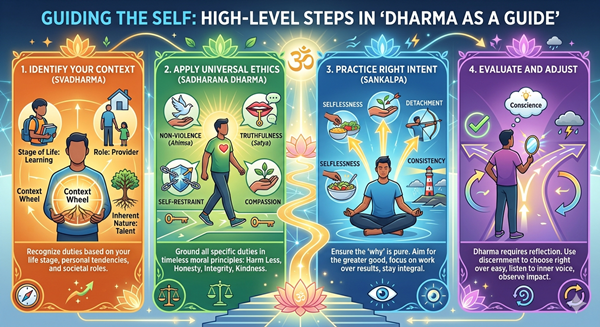
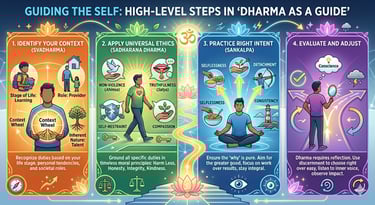
In a contemporary setting, this manifests as a sophisticated form of situational ethics. It suggests that there is a "right" way to act in every given moment, but that rightness is not a static, universal rule. It is deeply dependent on our role, our stage of life, and the specific circumstances we face. This is why dharma is often described as a personal operating system. It provides the logic for navigating complex social and professional landscapes without losing our center.
To truly grasp dharma, one must first clear away the misconceptions that have clouded its meaning over centuries. It is not a rigid set of commandments etched in stone. Unlike Abrahamic traditions that often rely on a list of "thou shalt nots," dharma is a living, breathing guidance system. It is also not a synonym for blind ritualism.
We can spend every morning in a church, temple or a meditation hall, but if we return to a life of exploitation or dishonesty, we are not practicing dharma. Rituals are merely tools intended to help us realize our dharma; they are not the goal itself.
The reason dharma is so frequently misunderstood in the 21st century is largely due to our obsession with individualism and rights over responsibilities. Modern culture teaches us to ask what the world owes us, whereas dharma asks what we owe the world. It's a start from what we owe to our self, our family, our society, our country and our world. It is a philosophy of duty and interconnectedness.
Another layer of confusion stems from the fact that dharma is context-dependent, which many people mistake for moral relativism. However, dharma is not "doing whatever we want." It is the opposite. It requires an objective, often difficult assessment of what the moment requires of us, even if that action is personally inconvenient or emotionally taxing.
An Example,
If I take the example of a Mother who is a Manager at a company.
At the Office: Her dharma is to be a fair boss. If her nephew works for her and performs poorly, she must give him a formal warning or fire him. At Home: Her dharma shifts. She is a supportive aunt who offers that same nephew a meal and emotional comfort.
The Reality: She isn't being "moody." She is fulfilling the inherent, natural trait or the requirements of two different roles. To keep him employed while he fails would be a "wrong" action (adharma), an adharmic action against her company.
The Difficulty lies in the situation faced. Firing a family member is emotionally taxing and creates conflicts. Her Dharma, her personal feelings (love for her nephew) must take a backseat to the objective duty of her professional role.
Practicing Dharma
Practicing dharma in the modern age requires a shift in perspective from the "self" to the "whole." It begins with an audit of our various roles. We can simultaneously be an employee, a child, perhaps a parent, a friend, and a citizen. Each of these roles carries a specific set of dharmic responsibilities. In a professional context, practicing dharma means performing our work with excellence and honesty, not merely for a paycheck, but because our work is a contribution to the stability of our company. As a friend, it means offering support and truthfulness even when it is uncomfortable. It is about maintaining the integrity of the relationships that hold our social world together.
When we choose to act with integrity despite no one watching, or when we fulfill a promise that has become difficult to keep, when we upholding dharma. We act as a structural beam in the architecture of our society and our humanity, preventing the roof from caving in on us.
Ultimately, dharma is about finding our place in the grand machinery of existence. It suggests that when we live in alignment with our true nature and our social obligations, we experience a sense of flow and purpose. This is not a promise of "happiness" in the fleeting, hedonistic sense, but a promise of "meaning", "a deep satisfaction", that "I did right".
There is no time and place for starting. By focusing on the "right now" and performing the task at hand with total presence and ethical clarity, we move away from the anxiety of the future and the regrets of the past.
By being 'dharmic' in our interactions is the practice of becoming a stabilizing force in the lives of others, because, we will always do the 'right thing'. It is our commitment to "right conduct" that prioritizes the health of the relationship and the social fabric over the immediate gratification of our ego. Practising this gracefully means our influence is felt through our presence and reliability rather than through loud moral posturing.
The Foundation of Dharmic Presence
The first step in dharmic interaction is the cultivation of a neutral, non-reactive presence. Most modern conflicts arise from a cycle of "action-reaction." When someone speaks with aggression, the standard response is to match that energy. Dharma breaks this cycle. Graceful conduct involves holding our own center so that we do not become a mirror for someone else’s chaos. This is not about being passive; it is about being the "adult in the room." By refusing to escalate unnecessary friction, weuphold the dharma of peace and clarity.
Dharmic Considerations
Communication is the primary tool for dharmic action. To speak dharmically [based on the principles of duty, righteousness and ethical behavior], one must pass their words through three filters: Is it true? Is it necessary? Is it kind? In professional and personal settings, we often speak to fill silence, to complain, or to assert dominance. Graceful dharma involves using speech to build structure. This means giving credit where it is due, offering constructive feedback without intent to wound, and maintaining the confidentiality of others. When we speak with integrity, our words carry weight, and people learn they can rely on us. This reliability is the bedrock of social order.
Even when conflict is unavoidable, dharma dictates the "right conduct" of engagement. A dharmic person does not seek to "win" a fight but to reach a resolution that aligns with the truth. This involves the grace of admitting when we are wrong and the strength of standing firm when a principle is at stake. It means fighting the issue, not the person. By keeping interactions focused on objective solutions rather than personal attacks, we preserve the dignity of both parties, ensuring that the relationship can survive the disagreement.
When we prioritize the "peace" of a relationship over the "truth" of a situation, we are engaging in what is often called Adharma—the opposite of right conduct. In Hindu philosophy, this is a failure of duty. Avoiding the hard truth out of fear of conflict may feel like kindness or "saving" the relationship, but it is actually a form of ego-preservation. We are choosing our own comfort (avoiding the stress of a fight) over the actual well-being of the other person and the integrity of the bond.
Personal Integrity is a loss that happens quietly. The first impact is internal. When we consistently witness something wrong but choose to stay silent, we create a state of internal friction. Every time we swallow the truth to keep the peace, we lose a bit of our selves. Over time, this leads to a loss of self-respect. We cease to be an authentic participant in our own life and instead become a character playing a role. This "silence" eventually turns into resentment, which is a slow-acting poison for any relationship.
The Stunting of the Other Person’s Growth By withholding correction, we are effectively handicapping the other person. If a person is acting in a way that is harmful, arrogant, or delusional, and we see it—by not providing that feedback, we are denying them the opportunity to evolve. We are essentially "enabling" their descent into worse habits. In the long run, this is an act of unkindness.
The Karmic Ripple Effect
In a broader sense, failing to stand for the truth contributes to a "low-trust" environment. When people in a society or a family stop holding each other accountable, the standard of behavior for everyone begins to drop. If we don't correct a toxic behavior, that behavior doesn't just stay with us —it spreads. That person will take that same behavior into their next interaction, their job, and their other friendships, believing it to be acceptable because no one had the courage to say otherwise. Our silence becomes a silent endorsement of chaos. Compassionate Candor is a necessity when we practice dharma. We don't have to be a harsh critic. It means offering the truth with the intent to heal, not to hurt. It is possible to be "firm on the truth, but soft on the person." This is the definition of grace in interactions: telling someone they are wrong in a way that makes them want to be right, rather than making them feel attacked.