
The Annual Autopsy: Why Earth Day is Just a 24-Hour Hall Pass
Explore a cynical, 21st-century take on Earth Day. Move beyond corporate greenwashing and political theater to hear a powerful message from the Earth herself. This blog strips away the hashtags to reveal the uncomfortable truth about our annual performance of environmental care and the urgent need for real, systemic change.
FEATURED
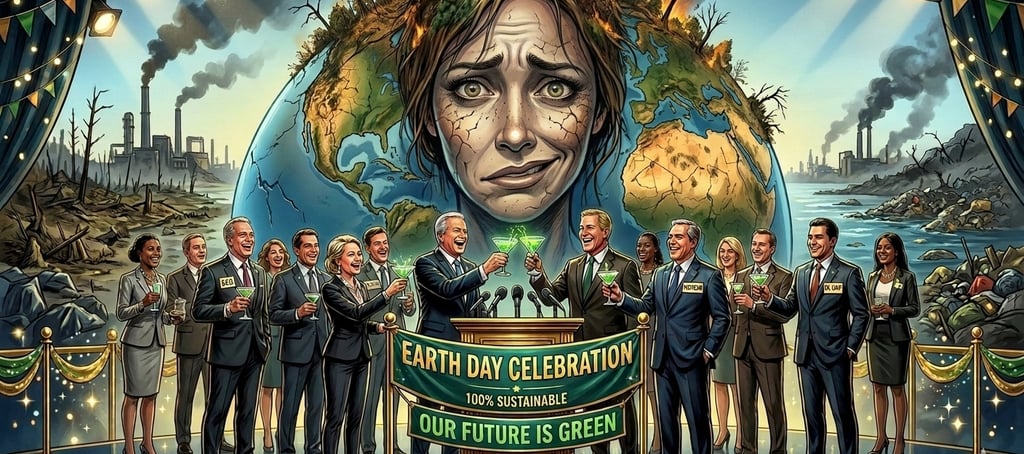
The 21st-century version of Earth Day has morphed into a high-gloss, corporate and political sponsored performance of "caring" that usually lasts about 24 hours before we return to our regularly scheduled programming of hyper-consumption.
The Annual Greenwashing Gala
In this century, Earth Day has become the "Valentine’s Day" of the corporate, political and 'anybody-with-influence' world. It is the one day a year when oil giants, politicians and fast-fashion moguls swap their logos for a slightly softer shade of green. They post, tweet about "our shared future," and then go right back to their quarterly growth targets that require stripping the planet of its resources. It’s an era where "sustainability" is more of a marketing budget item than a biological necessity.
Governments have turned Earth Day into a high-stakes photo op. In this century, climate policy is less about carbon and more about optics. Politicians fly private to summits to sign "non-binding" agreements with deadlines set so far into the future (2050, 2070) that neither they nor their voters will be alive to see the failure. It’s a "kick-the-can" philosophy where the goal isn't to solve the problem, but to survive the next election cycle without upsetting the donors [Guess Who?] who profit from the status quo.
It's a Political Tug-of-War . where the earth has been reduced to a partisan football. Depending on which way the political wind blows, the environment is either "the end of the world" or "a hoax to kill jobs." In the 21st century, "Green Policy" is often just a convenient tool for wealth redistribution or tax hikes that rarely seem to make it back into the soil. It’s a game of musical chairs where the music is a dying forest and the chairs are subsidies for technologies that aren't even ready yet.
The Paradox of Digital Activism
We celebrate the Earth by using devices made of rare-earth minerals mined in questionable conditions, powered by grids that still largely breathe coal. The 21st-century activist "saves the planet" with a hashtag from a smartphone that is designed to be obsolete in 24 months. We’ve managed to turn environmentalism into a trend—something you wear, post, share, or 'go-through-a-24-hour-attention-cycle' rather than something you do. The irony of a billion people using energy-intensive servers to talk about "saving energy" for a day is the peak of our modern contradiction.
Consuming Our Way to a Cure
The most cynical twist of the last two decades is the idea that we can shop our way out of an ecological crisis. We are told to buy more "eco-friendly" products, more "organic" cotton, and more "reusable" bags—ironically creating a mountain of "green" waste. Earth Day now often serves as a massive sales event. Instead of a day of austerity or reflection, it’s a day where we are encouraged to upgrade to the latest "green" version of things we probably didn't need in the first place. In 24 hours, by April 23rd, the "Mother Earth" banners are in the trash, and the private jets are back in the air. We’ve turned a survival imperative into a seasonal festival. In this century, Earth Day doesn't represent a shift in the system; it represents the system’s ability to absorb dissent, package it, and sell it back to us with a recyclable bow. It’s a collective deep breath we take once a year just so we can hold our noses for the
other 364 days.
For the person on the street, Earth Day feels like a lecture from folks who pay vocal support with short term or in-effective commitments. The average person is told to stop using plastic straws and turn off their lights, while they watch a single billionaire’s "joyride" to the edge of space emit more carbon than a village does in a year. The "Common Man" perceives the movement as a burden placed on the poor to atone for the sins of the rich. We are told to "save the Earth" while we are struggling to save enough for rent, making the whole celebration feel like a luxury hobby for those who can afford "organic" everything.
We’ve been told the world is ending every April for decades, yet the commute stays the same and the plastic piles higher. The average person treats Earth Day like a mandatory HR meeting—you nod, you agree it’s important, you wait for it to be over, and then you go get a burger in a Styrofoam box because it’s the only thing you can afford on a 15-minute lunch break.
The Patient on the Table - The Gaslit Patient
If Earth were a person, she’d be lying on a hospital bed while her "family" (we) stands around her bed arguing about the cost of the medicine. In this century, she is the victim of the ultimate gaslighting. We tell her we love her every April, buy her a "green" card, and then spent the other 364 days slowly poisoning her water and pumping smoke into her lungs. She runs a persistent, worsening fever, while she warns us. Her "shivers" are the erratic storms; her "sweats" are the melting glaciers. But instead of cooling her down, her doctors (governments) are just debating the thermostat settings for thirty years from now. She’s watching us celebrate "Earth Day" with the same cynicism a person feels when an abusive partner brings home flowers once a year to make up for a year of neglect. She doesn't want the flowers; she wants to be able to breathe.
Earth has become a background character in her own life story. We talk at her and about her, but never to her. In the 21st century, we treat her like a "resource" to be managed rather than a person with rights. She’s the silent witness to our "Green Summits," watching the very people who claim to save her carve her up into "carbon credits" and "mineral rights." To her, Earth Day isn't a celebration; it’s a yearly reminder that her children have forgotten she is actually alive.
An Unsent Letter
"I do not need your posters, your slogans, or your one day of curated 'awareness.' I do not need you to 'save' me—I have survived ice ages, meteors, and the shifting of continents long before your first breath, and I will be here long after your last. What I need is for you to see me again. Stop treating me as a stage for your dramas or a storehouse for your greed. I am not a backdrop; I am your skin, your breath, and the very salt in your blood. When you hurt me, you hurt yourselves."
"Remember the feeling of cool grass under your feet, or the way the rain smells before it hits the dust? That is my heartbeat. I have given you everything without a single invoice—the oxygen in your lungs, the water that composes your being, and the gravity that holds you close so you don't drift into the void. I have been absorbing your waste and cooling your fevers, hoping that one day you would grow out of your infancy and realize that we are the same. I don't want your guilt; I want your kinship."
I will continue to turn, to bloom, and to breathe, with or without you. But I want you here. I want to be the soil for your gardens and the shade for your children. My message is simple: Stop performing for me and start living with me. if only you would stop talking and finally listen."